


Key Points:
- ABA caregiver training helps families track whether therapy skills carry into daily routines between sessions.
- Caregivers can follow one skill, record responses and prompt levels in five short lines, and watch for less support, broader use, and consistency.
- Weekly notes give BCBAs context for care-plan decisions.
Tracking progress at home should never feel like designing a separate clinical plan. Effective practice stays grounded in your child's existing care plan and the specific steps recommended by your BCBA. Active participation in our caregiver coaching services is required by both insurance providers and clinical standards because real growth happens when strategies extend into daily living.
How ABA Caregiver Training Defines a Useful Home Check
Understanding caregiver training goals in ABA therapy starts with clarity on what to observe. Before writing down any notes, talk with your BCBA to clarify four essential details:
- The specific skill targeted for the week
- The natural daily routine where the skill fits
- The exact prompt or support level currently used during sessions
- The specific behavior change your BCBA wants you to watch for
Caregivers often leave meetings knowing communication is a primary goal, yet feel unsure about what that looks like during dinner. When we guide families at Aluma Care, we focus on concrete examples, like watching whether a child points to a cup rather than reaching silently, so observation becomes straightforward and actionable.
Track Progress Based on Your Caregiver-Coaching Plan
Home tracking can look different from one family to another. Your BCBA will develop an individualized caregiver-coaching plan with your input, including what to observe, how often to practice or track it, and what information to bring to coaching sessions.
Some plans may focus on one skill during one routine for part of the week. Others may include several opportunities or more regular data collection across selected routines.
Depending on the plan, possible examples may include:
- Requesting a preferred item during snack preparation
- Completing one cleanup action after playtime
- Using a non-vocal pointing gesture before receiving a toy
- Practicing one step in a handwashing or hygiene routine
- Moving from playtime to dinner with agreed visual supports
Your BCBA may also ask you to note prompt levels, responses, or changes across the week. Caregiver involvement should follow the plan you and your BCBA agreed on, so the amount of practice or tracking may be lighter or more frequent based on your child’s current goals.
Caregiver coaching gives you regular time to review those observations and discuss whether anything in the plan needs to change.
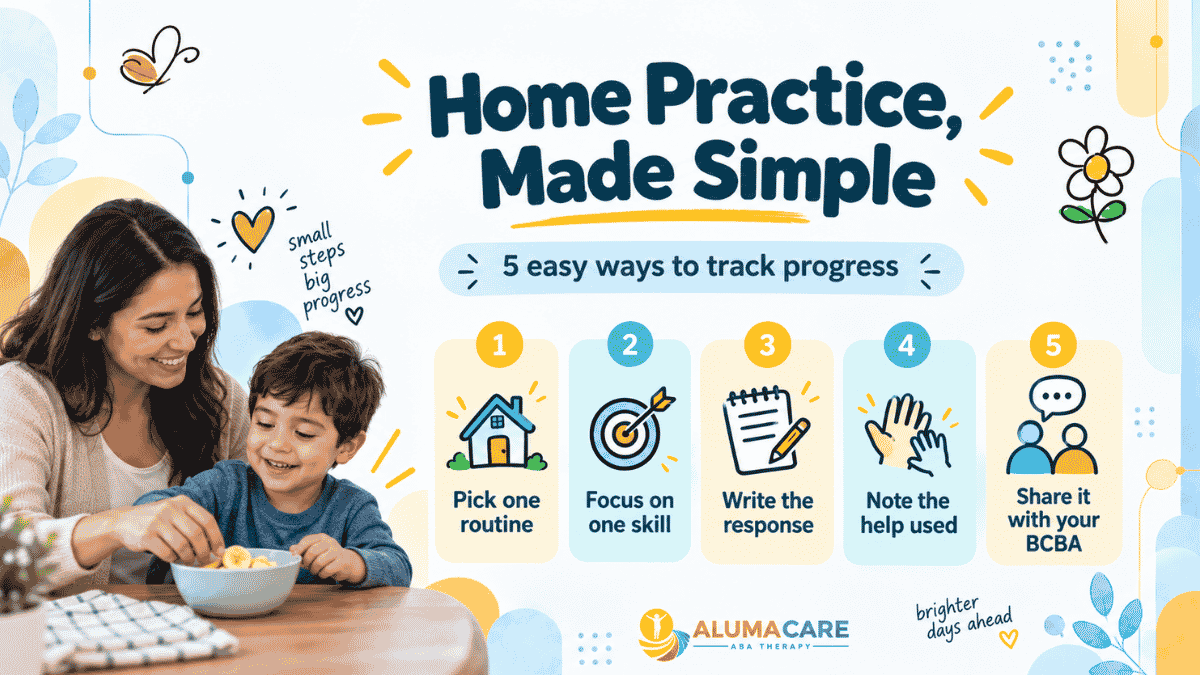
How to Track ABA Therapy Progress in Five Short Lines
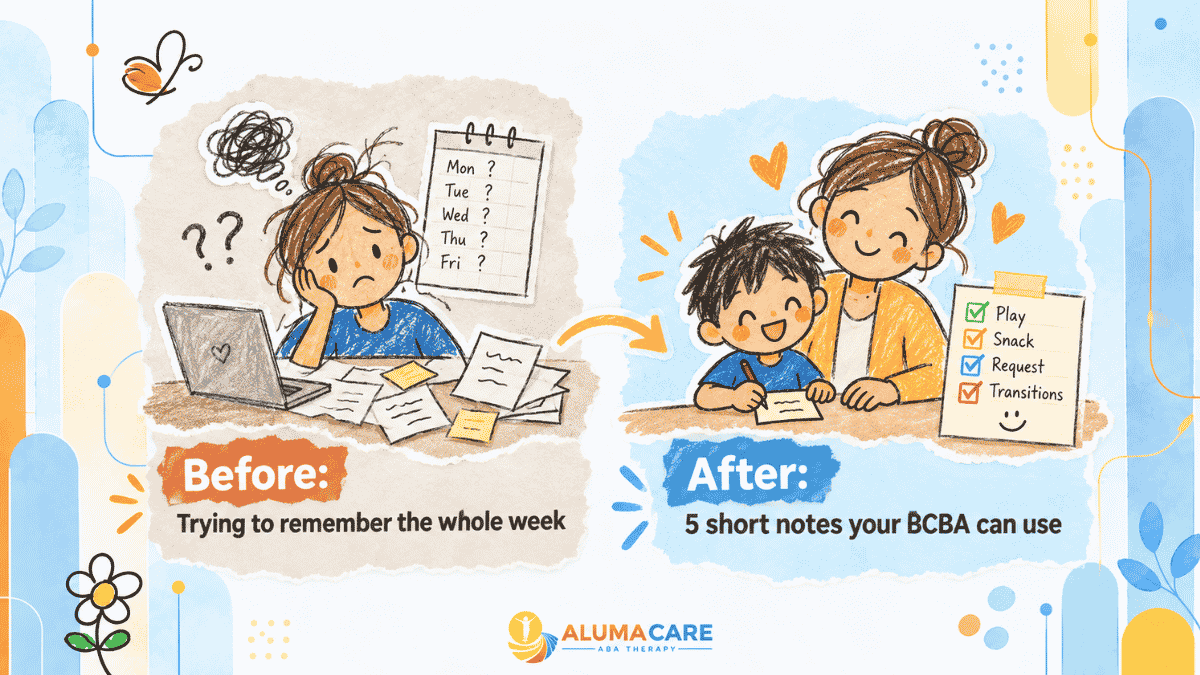
You do not need complex spreadsheets or clinical terminology to collect good information. A quick five-line note gives your BCBA clear context about how your child performs outside of formal sessions.
Use this simple five-line structure for your notes:
- Routine: Name where and when the moment happened.
- Target: List the specific skill practiced.
- Response: Describe what your child did.
- Support: Record what prompt, gesture, or help you provided.
- Context: Note any unusual factors, like tiredness or schedule shifts.
A sample note might look like this:
Snack time. Target was requesting crackers. Child pointed after one verbal prompt. Yesterday needed two prompts. Routine occurred thirty minutes late due to an appointment.
Knowing how to track ABA therapy progress this way helps you record objective facts rather than guessing whether a week went well. These brief entries make it easier to evaluate ABA therapy progress at home between sessions with your BCBA, especially when they connect to clear ABA parent training goals.
If a day gets busy and practice does not happen, share that openly. Irregular days give your team valuable context about real-life schedules.
Partner With Your Care Team
At Aluma Care, our caregiver coaching provides hands-on guidance and regular progress reviews centered on your family's daily routines. You can share your short home notes during regular BCBA meetings to see what each pattern means for your child's care plan. Reach out to us today.
Look for Three Changes Before Calling It a Pattern
True progress appears over time across multiple opportunities, rather than in one isolated moment. Clinical guidelines from the Council of Autism Service Providers emphasize evaluating measurable goals across natural settings to confirm meaningful growth.
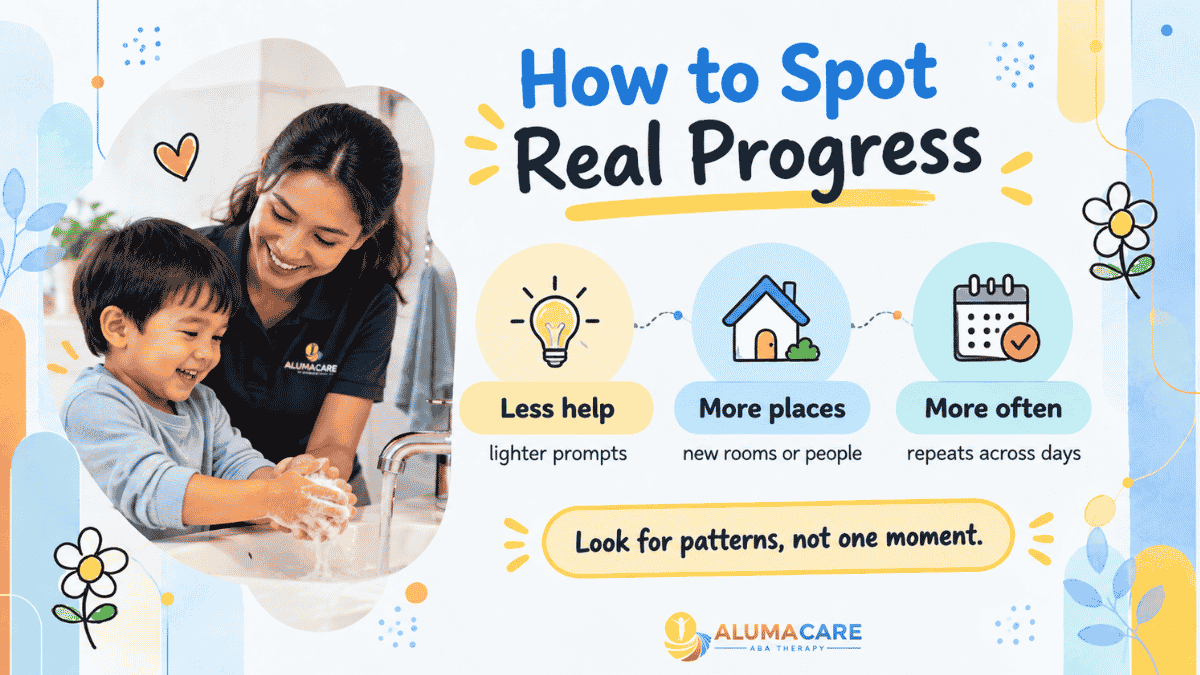
Look for these three indicators during daily routines:
- Less support: Your child completes the skill with lighter prompts, fewer reminders, or greater independence.
- Broader use: The skill shows up with different family members, in new rooms, or with new items.
- More consistent use: Your child performs the skill across several consecutive days or opportunities.
Small steps count as real success. A child who still requires help but completes one additional step independently is moving in the right direction. Your BCBA will help identify which specific markers match your child's current targets, often drawing on ongoing ABA assessments to confirm the next step.
ABC Notes Can Help You Record a New Behavior
A new behavior may come up between caregiver-coaching sessions. Your BCBA may ask you to write down a few details around what happened so you can review the event together. ABC notes can help organize those observations without asking you to interpret the behavior or change the care plan on your own.
A simple ABC note may include:
- Antecedent: What happened right before the behavior, such as an activity, request, transition, or change in the routine.
- Behavior: What you could directly see or hear. Specific descriptions are more useful than labels such as “upset” or “uncooperative.”
- Consequence: What happened right after, including how others responded or whether the activity continued or ended.
- Context: Details such as the time, location, people present, or an unusual change in the day that may be worth mentioning.
Your caregiver-coaching plan may call for more, less, or different information. The notes give your BCBA details to review with you during an upcoming meeting, where the BCBA can discuss possible patterns and decide whether any changes to the individualized plan are appropriate.
Turn Home Notes Into Better BCBA Decisions
Here at Aluma Care, active participation in caregiver training connects clinical targets directly with your home life. Regular coaching sessions give you dedicated time to discuss observations, receive direct modeling, and ask questions.
Bring these practical questions to your next BCBA meeting:
- Are we focusing on the correct step of this skill?
- Are we using the exact same prompt level used during sessions?
- Is our child needing less assistance across repeated attempts?
- Should we continue practicing within this same routine next week?
- Which details are most helpful for us to write down?
- Does this goal need a smaller intermediate benchmark?
These discussions highlight the benefits of caregiver coaching in ABA therapy. By comparing your notes with session data, your BCBA can refine strategies, adjust prompts, or move to new targets safely. Caregivers provide the real-world context, while the BCBA manages clinical adjustments.
FAQs About ABA Caregiver Training and Home Progress
How much home practice should a caregiver complete?
Your BCBA determines the recommended practice based on your care plan. Focus on brief, natural opportunities during existing routines rather than running long sessions. Consistent practice during one daily activity provides better information than trying to cover multiple rushed routines.
Can two caregivers see different progress with the same skill?
Yes. Children often respond differently depending on who is present, the environment, or the prompts used. Both observations are valuable. Record what happens in each situation and share both notes with your BCBA during your next review.
Can ABA caregiver training happen through telehealth?
Aluma Care offers virtual caregiver coaching options depending on your child's plan, location, and insurance coverage. Ask your intake coordinator or BCBA if telehealth sessions are suitable for your family's schedule and training goals.
Review Your Child's Home Practice With a BCBA
Tracking home progress works best when focusing on small benchmarks, consistent routines, and reduced prompt levels over time. Brief notes help you share clear context with your care team without adding extra stress to your day.
At Aluma Care, we help caregivers in Kansas and New Hampshire connect daily observations with their child's ABA care plan. Our team can explain caregiver training options, review service settings, and guide you through each stage of intake.
Call our Kansas team at +1 913-232-2003 or our New Hampshire team at +1 603-903-1003. After you reach out, our intake team will discuss ABA caregiver training options, service settings, insurance coverage, and next steps.
EDITOR’S NOTE: Content was written by an outsourced marketing team and reviewed by Aluma Care’s clinical leadership for accuracy and service alignment. It is for educational purposes and does not replace individualized medical or clinical advice.









.png)


.png)