


Key Points:
- A quality ABA therapy provider in New Hampshire should present a care plan that clearly explains individualized goals, service hours, BCBA supervision, caregiver coaching, and progress tracking.
- Families should compare each section with assessment findings and daily priorities.
- Missing details or generic goals deserve questions before approval.
When an evaluation finishes, reviewing the paperwork can feel like looking at a document written in code. A written care plan explains what a clinical team learned during assessment, which skills your child will practice, how supervision works, and how you will participate.
Working with a quality ABA therapy provider in New Hampshire means you get a partner who walks through every page with you before services start. This guide breaks down each section of the document so you can feel prepared when you speak with your Board Certified Behavior Analyst (BCBA).

What Does a Quality ABA Therapy Provider in New Hampshire Include in a Care Plan?
A solid ABA therapy plan in New Hampshire gives you a clear snapshot of where things stand and where they are heading. The document outlines current skills, personal goals, recommended schedule details, supervision structures, caregiver coaching plans, and progress tracking methods.
State regulations shape how these documents look for insurance approval. Under state law, applied behavioral analysis is recognized as a covered treatment, allowing insurance companies to request a formal plan detailing the frequency and duration of services.
An ABA therapy provider checklist for your document should include:
- The supervising BCBA's name and contact information
- A clear summary of your child's current strengths and skills
- Specific skill-based targets chosen for therapy
- The recommended weekly service schedule
- The caregiver coaching plan and meeting frequency
- The schedule for progress reviews and plan updates
How Should the Plan Describe Your Child’s Current Skills?
The opening section of the plan sets the baseline for everything that follows. It describes how your child currently communicates, plays, manages daily routines, or asks for support during challenging moments. You should easily recognize your child in these paragraphs, as they ought to focus on real observations rather than broad medical labels.
Vague summaries make it hard to track growth over time. For instance, a vague plan might simply state that a child struggles with communication. A useful plan explains that a non-vocal child may guide an adult toward a favorite snack, but does not yet use a picture system, gesture, or speech device to request it.
Questions you can ask your BCBA about this section:
- Which assessment observations support this description?
- Does this summary reflect what you see happening at home?
- Are there specific strengths or examples we should add to this page?
Do the Goals Connect to Daily Routines and Caregiver Priorities?
Caregivers sometimes arrive at a planning meeting with several priorities, only to see one or two listed as immediate targets.
With the many households we support across Manchester, Nashua, Concord, and Keene, we know that starting with a few foundational steps often creates a smoother path toward bigger goals later on. Your BCBA can explain the order of these targets, so you see how they build toward long-term success.
You might want to ask:
- Which of our family priorities does this target support?
- How will my child practice this during our normal daily routine?
- What smaller milestones need to happen before we move to the next step?
How Should the Provider Explain Recommended ABA Service Hours?
Recommendations depend on your child's individual needs, the number of goals, and your family's schedule rather than a standard company policy. A clinical recommendation breaks down how time is spent each week. This includes direct 1-on-1 sessions with a behavioral technician, supervision time with the BCBA, and regular caregiver coaching meetings.
How a Quality ABA Therapy Provider in New Hampshire Explains Service Hours
Living in New Hampshire means practical factors can shape your schedule. Long travel distances or sudden winter weather disruptions across the state can impact in-home ABA therapy visits. A quality ABA therapy provider in New Hampshire will discuss these real-world logistics separately from clinical needs, ensuring your schedule remains workable all year round.
Questions to ask about service hours:
- What specific clinical findings support this number of hours?
- How are these hours divided between direct sessions, supervision, and caregiver coaching?
- How will we adjust scheduling if our family routine changes or weather delays occur?
Ask Us About Your Child’s Proposed Care Plan
At Aluma Care, our New Hampshire team reviews each proposed ABA care plan directly with caregivers. Our BCBAs explain every skill-based target, supervision schedule, and coaching requirement before services begin. Reach out to our team today to discuss how our in-home programs support your family.
Where Should BCBA Supervision and Caregiver Coaching Appear?
A complete plan clearly details how the BCBA will supervise the program and support your household. The behavioral technician carries out daily sessions, but the BCBA monitors data, adjusts goals, and guides clinical decisions.
Active participation in caregiver coaching support is a core requirement of our programs and is often mandated by insurance providers. Research on caregiver training demonstrates that real-time feedback and hands-on guidance help caregivers successfully teach daily living skills at home. These sessions usually happen weekly or biweekly, giving you time to talk directly with your BCBA.
Common topics covered during caregiver coaching include:
- Reviewing your child's recent progress and session data
- Practicing approved strategies during normal home activities
- Asking questions about behavioral techniques used during sessions
- Planning for changes in home routines or family schedules
How Will the Plan Measure and Explain Progress?
Tracking progress is a daily part of ABA therapy, and the plan should describe how that information is gathered. During each session, the behavioral technician records data on target skills. You do not need to read complex graphs or technical terms to understand what is happening, as your BCBA will translate these numbers into plain language.
Questions to ask about progress tracking:
- How often will the BCBA review session data with me?
- What does the team do if a target shows little or no change after several weeks?
- How are my observations at home added into official progress reports?
Which Care Plan Details Deserve More Questions?
An unclear sentence or unfamiliar phrase does not mean a provider delivers poor care. A short conversation with your BCBA often resolves confusion about goals or schedules. However, noticing patterns where important details are missing can help you decide how to choose ABA therapy in NH with ease.
When searching for the best ABA therapy in Manchester, NH, comparing what a company promises with what they put on paper is a helpful step. Knowing potential red flags in an ABA therapy provider helps ensure your family receives transparent, high-quality support.
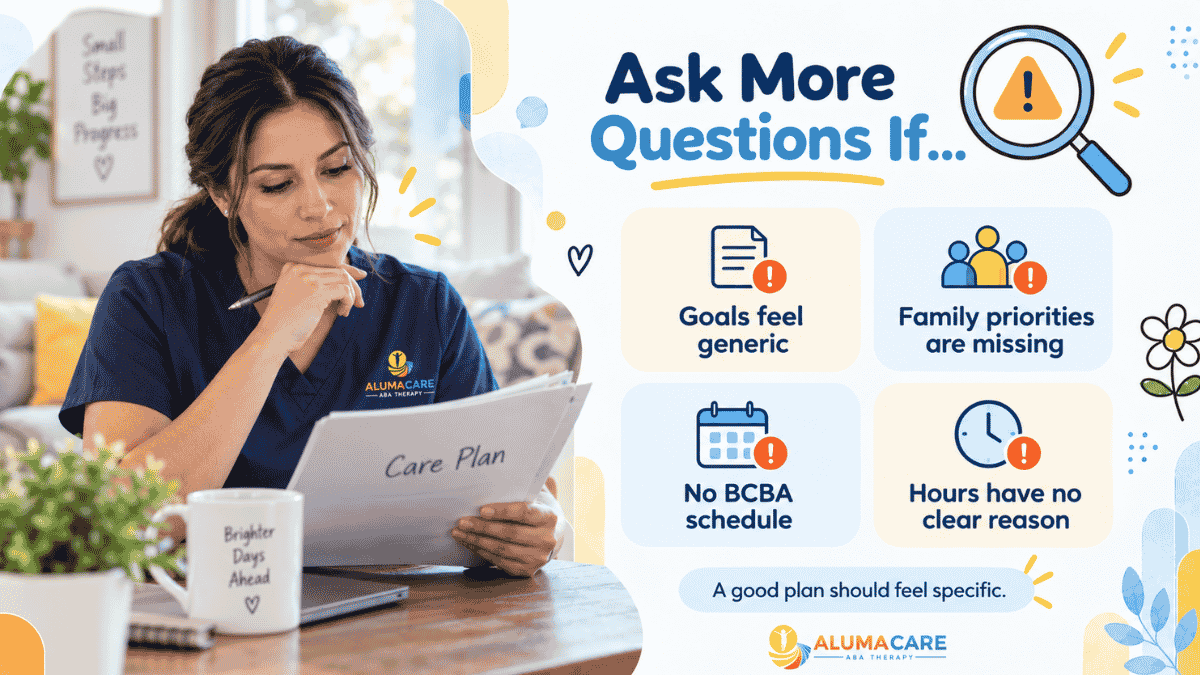
Look out for these common warning signs in a document:
- Goals that look generic enough to fit almost any child
- No mention of your family's personal priorities or home routines
- Missing names or schedules for BCBA supervision
- A total lack of scheduled caregiver coaching hours
- Recommended service hours provided without a clinical explanation
- Behavioral technicians expected to make clinical plan changes on their own
What Happens When the Care Plan Needs to Change?
A plan may need an update when your child meets a target, shows a new area of need, or experiences a major routine change at home. Your BCBA reviews current session data and your feedback before writing any official revisions.
You should always receive a copy of any updated plan and have time to discuss changes before they start. In New Hampshire, insurance coverage often requires formal documentation for updates during re-authorization periods.
Questions to ask during plan updates:
- What recent progress led to this new goal?
- Will this update require a new review by our insurance company?
- How will the behavioral technician introduce this new target during sessions?
What We Often See When Caregivers Understand the Plan
At Aluma Care, our team often sees caregivers feel far more confident once every page of the care plan is explained in clear terms. Someone who enters a meeting feeling uncertain about recommended hours often leaves with a clear understanding of their child's skill-based targets and how coaching sessions will work.
A well-written plan serves as a shared reference tool for every caregiver coaching session. Rather than sitting in a file cabinet, it guides daily collaboration between your family and clinical team.

FAQs About ABA Care Plans in New Hampshire
Can I ask for changes before agreeing to an ABA care plan?
Yes. You can ask your BCBA to explain or adjust any goal, schedule recommendation, or coaching requirement before signing. The BCBA will discuss the clinical reasoning behind the proposal and work with you to ensure your individualized ABA therapy plan reflects your family's priorities.
Will I receive a copy when the care plan changes?
Yes. Your provider should give you a revised copy whenever goals or service hours update. You can ask your BCBA when the new document will arrive, which sections were modified, and whether your insurance requires a new signature.
What happens if insurance approves fewer hours than the care plan recommends?
Your BCBA will review the approved authorization with you and explain how the schedule adjusts. You can discuss whether the provider can submit additional clinical documentation, request an appeal, or focus immediate sessions on your highest-priority skill-based targets.
Discuss Your Child’s ABA Care Plan With Aluma Care
An ABA care plan should give your family an understandable view of proposed goals, supervision schedules, caregiver coaching, and progress tracking. Every section ought to connect directly to your child's assessment and daily home needs.
At Aluma Care, our team provides individualized in-home ABA services for families across New Hampshire and Kansas. Call New Hampshire at +1 603-903-1003 or Kansas at +1 913-232-2003 to discuss your child’s care plan, verify coverage, and learn how in-home ABA therapy can support your child’s goals.
────────
EDITOR’S NOTE: Content was written by an outsourced marketing team and reviewed by Aluma Care’s clinical leadership for accuracy and service alignment. It is for educational purposes and does not replace individualized medical or clinical advice.


.jpg)





.png)


.png)