


Key Points:
- How long ABA therapy sessions are depends on a child’s assessment, goals, care plan, and response to services.
- Focused ABA may include 10 to 25 hours per week, while broader programs may include 30 to 40.
- BCBAs divide those hours across visits and adjust session length or frequency as needs change.
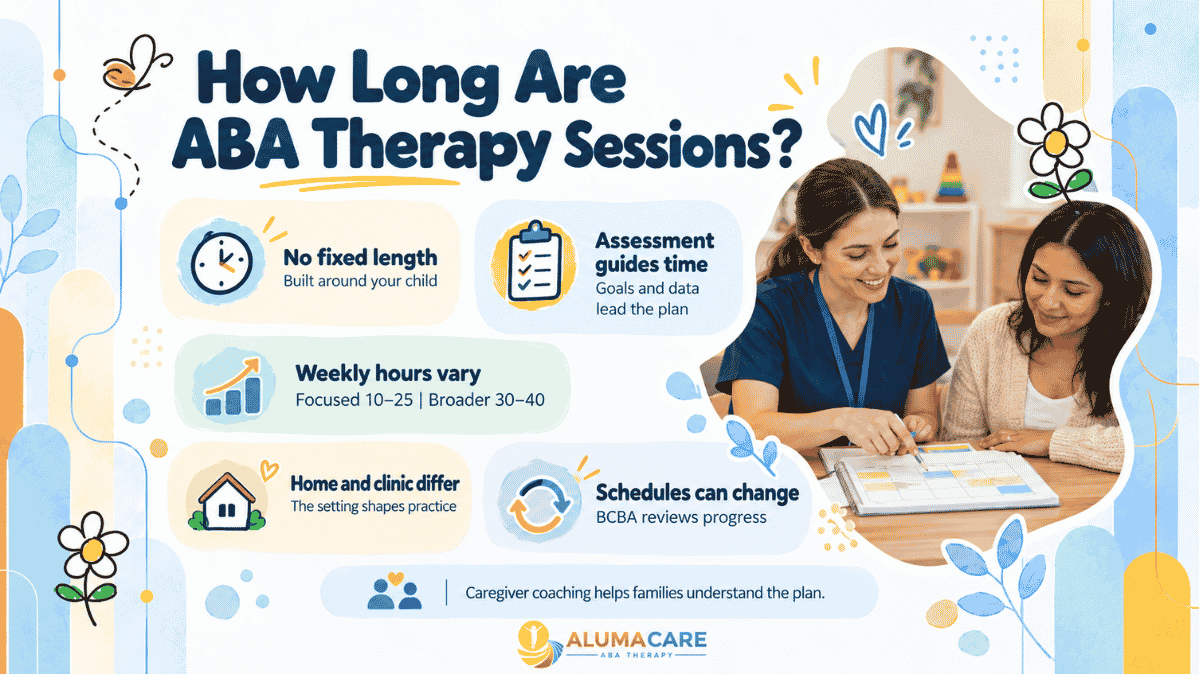
There is no single answer to how long ABA therapy sessions are. Session length depends on your child’s assessment, current goals, care plan, and response to services. A recommendation for 20 or 30 weekly hours can sound like a lot when you start thinking about meals, work, appointments, and family routines.
At Aluma Care, our ABA therapy services follow an individualized care plan and keep caregivers involved through regular coaching. Your BCBA can explain how individual visits connect to the full weekly schedule. The sections below explain what can shape session length, weekly hours, and scheduling.
How Long Are ABA Therapy Sessions and Why the Answer May Vary
ABA therapy session length can look different from one child to another. A Board Certified Behavior Analyst (BCBA) reviews the child’s current needs and decides how to structure each visit.
Several factors may affect that decision:
- Current skill-based targets
- The number of active goals in the care plan
- Data from recent sessions
- How your child responds during direct services
- The setting where sessions take place, such as home or clinic
- The number of other service hours (e.g., school, other therapies) your child is currently receiving
Individual visit length and total weekly hours also mean different things. One describes a single appointment. The other describes the amount of direct service across the week.
What Determines the Length and Frequency of ABA Sessions?
A BCBA uses ABA assessment findings and ongoing data to decide how often sessions should happen. The care team reviews progress and updates the schedule when the child’s needs change.
Factors may include:
- The scope of current skill-based targets
- Skills that need repeated practice during the week
- Recent progress data collected during sessions
- Changes in how your child responds to current ABA programs
- Environments where your child can practice independence goals
Session frequency can change even when services continue toward the same broader goals. Your BCBA may spend more time on one target for a period, reduce time on another, or introduce a new target after reviewing progress. Caregiver coaching gives you a regular place to ask how those changes affect the weekly plan.
How Long Are ABA Therapy Sessions When a Care Plan Changes?
Individualized ABA care plans may change as children meet goals, build new skills, or need support in another area. Your BCBA may adjust session frequency or duration after reviewing your child’s progress.
The Council of Autism Service Providers (CASP) explains that ABA treatment planning should use assessment information and ongoing evaluation rather than one schedule for every child.
A schedule change can also reflect new milestones. The BCBA may update the plan when your child needs less support with one skill or starts working on another. Regular caregiver coaching can help you understand why the schedule changed and what the team plans to work on next.
How Many Hours of ABA Therapy Can a Weekly Plan Include?
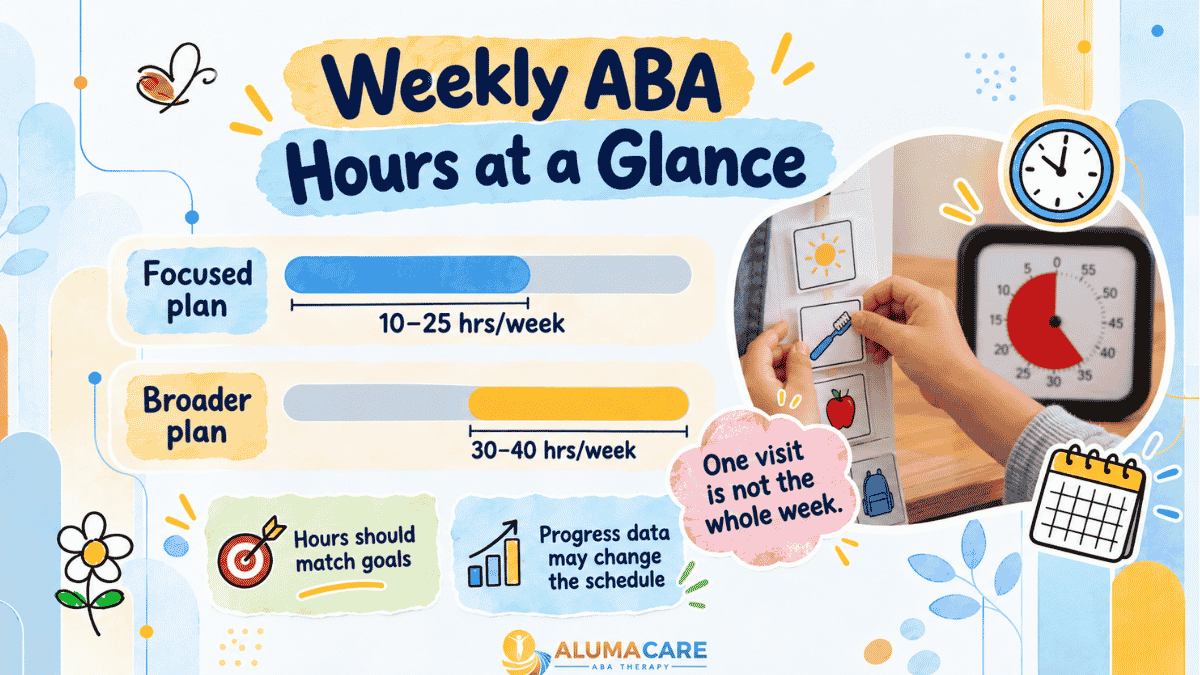
Caregivers often ask how many hours of ABA therapy a child may receive in one week. CASP’s 2024 practice guidelines describe broad ranges based on the scope of treatment:
- Focused ABA: Often 10 to 25 hours of direct treatment per week for a smaller set of targets
- Comprehensive ABA programs: Often 30 to 40 hours of direct treatment per week when the care plan addresses needs across several areas
These ranges give context, but they do not create one required number for every child. A 2024 meta-analysis reviewed 144 studies involving 9,038 young children with autism. Researchers found that more intervention hours did not consistently lead to better outcomes within the intervention types they studied.
A 2026 study analyzed data from 621 children ages 2 to 6 across 15 studies. Researchers found that weekly treatment hours were linked to changes in the outcomes they measured. However, none of those studies randomly assigned children to treatment groups, which limits certainty about the results.
The two studies examined different intervention groups and used different research methods. A caregiver can get more useful information from the reason behind a recommendation than from one universal number. The BCBA should connect recommended hours to the child’s assessment, goals, and response to services.
A weekly number becomes easier to understand when you know which goals that time supports. Contact Aluma Care to ask how your child’s assessment, care plan, caregiver coaching, and proposed schedule connect.
How an ABA Therapy Schedule May Look Different at Home and in a Clinic
Your family’s ABA therapy schedule may include sessions at home or in-clinic ABA sessions, depending on the care plan and current service availability. At Aluma Care, we offer both settings whenever possible. Each setting gives our team different opportunities to work on skill-based targets.
Home sessions may include:
- Communication during play
- Requesting help during daily routines
- Waiting during meal or snack preparation
- Steps within personal hygiene routines
- Independent play in a familiar space
Clinic sessions may use structured activities, specific materials, and planned opportunities that match your child’s targets. The setting alone does not decide the total weekly hours. Your child’s assessment and care plan guide how our team uses session time.
Our first sessions almost always require some special setup. Your BCBA can tell you which toys, materials, or activities to have ready before an in-home visit. That conversation helps the behavioral technician start with items that support the planned ABA programs.
Caregiver Coaching Remains Part of the Schedule in Every Setting
Caregivers actively participate in coaching whether direct sessions happen at home or in a clinic. At Aluma Care, caregiver coaching happens regularly, often weekly or biweekly. These sessions give you direct time with your BCBA to discuss progress, share observations, and learn strategies tied to your child’s care plan.
Caregiver coaching can cover questions such as:
- Why did the BCBA recommend this schedule?
- Which goals connect to the weekly hours?
- What does recent progress data show?
- Which strategies can caregivers practice between visits?
- When should the team review the schedule again?
Consistent approaches can support skill use across daily routines when caregivers follow the child’s care plan and the BCBA’s coaching.
One family that worked with us described seeing changes in both communication and behavior as their daughter’s program continued. Coaching gave the caregiver a regular place to share those observations while the BCBA reviewed session data.
Which Questions Should Caregivers Ask About ABA Therapy Hours per Week?
Questions about ABA therapy hours per week should focus on the reason behind the recommendation. Your BCBA can connect each part of the schedule to the assessment and current targets.
Useful questions include:
- Which assessment findings support these weekly hours?
- Which skill-based targets will the team address during these sessions?
- How will the team divide total weekly hours across individual visits?
- How often will the BCBA review the service schedule?
- Where does caregiver coaching appear in our weekly routine?
- What changes could lead the BCBA to adjust session length or frequency?
These conversations can make the weekly plan easier to understand. At Aluma Care, your BCBA remains your main contact for progress updates, schedule changes, and caregiver coaching.
Regular coaching gives families a place to discuss the same balance between learning, participation, and daily routines.

FAQs About How Long ABA Therapy Sessions Are
Do I still participate if my child receives ABA in a clinic?
Yes. Caregiver coaching remains an active part of Aluma Care services regardless of setting. Regular sessions with your BCBA give you time to review progress, ask questions, and practice strategies connected to the care plan.
Who should I ask if the ABA schedule feels difficult for our family?
Your BCBA is the first person to ask. Caregiver coaching provides dedicated time for families to discuss scheduling concerns alongside goals and progress.
Review Your Child’s ABA Schedule With Our Team
ABA session length and weekly hours should reflect your child’s assessment, current goals, and response to services. Regular caregiver coaching can help you understand the recommendation and how individual visits support the care plan.
Our team supports families in Kansas and New Hampshire with individualized ABA services and caregiver coaching. Contact our team to learn about the assessment process and scheduling, or speak with your assigned BCBA about an existing plan. Kansas caregivers can call +1 913-232-2003, and New Hampshire caregivers can call +1 603-903-1003.
────────
EDITOR’S NOTE: Content was written by an outsourced marketing team and reviewed by Aluma Care’s clinical leadership for accuracy and service alignment. It is for educational purposes and does not replace individualized medical or clinical advice.

_20250709_220456_0023%5B1%5D.jpg)
_20250709_220455_0020%5B1%5D.jpg)
_20250709_220455_0013%5B1%5D.jpg)
_20250709_220455_0011%5B1%5D.jpg)


_20250709_220455_0005%5B1%5D.jpg)
_20250709_220455_0003.jpg)







.png)


.png)